

Hervey Bay 2050: From Hidden Gem to National Player


Let’s start with a little time travel.
Think back to the year 2000, when the indestructible Nokia 3310 ruled your pocket.
You were sending SMS messages, slowly realising that email was here to stay, the best-selling car was a Holden Commodore, and the Brisbane Broncos were NRL champions.
Fast forward twenty-five years to today.
You own an iPhone, send messages on WhatsApp, rely on ChatGPT to help write emails, the best-selling car is now a much larger Toyota HiLux, and while the 2025 NRL winner is still undecided, the Broncos’ chances are a mystery.
At first glance, the changes over a generation are obvious.
Technology has leapt forward, but the core human experience has not shifted much.
We still go to school, fall in love, have kids, yell at the footy on weekends, sip a XXXX, retire, grow old, and eventually pass on.
By 2050, Hervey Bay will wear a different face, a larger, busier city, shaped by technology we can barely imagine today.
Skylines will shift, streets will feel new, and the rhythm of daily life will move to a faster beat.
Yet beneath it all, the essence of being human will remain untouched. Change will redraw the map, but the constants of life will always be there.
Hervey Bay is no longer just a sleepy retirement haven. It’s a regional city on the cusp of something bigger.
Its economic foundations, tourism, health and aged care, and retail, are solid.
Its reputation as a coastal lifestyle destination is growing.
And the national context is shifting in its favour.
Australia’s population will continue to grow at between 300,000 and 400,000 people a year.
The nation is ageing rapidly and will rely on skilled migration to maintain a strong working-age population.
For Hervey Bay, the doubling of the aged care sector over the next fifteen years will be particularly significant.
Our tax system is heavily dependent on income tax, over half of all tax revenue, so Treasurers will want to keep attracting high-earning, tax-paying migrants, even if political leaders talk about cutting migration to appeal to voters.
Historically, new migrants flocked to Sydney and Melbourne for job opportunities, but housing affordability is pushing more people towards regional areas.
Remote work is here to stay, and older populations increasingly require local care and services.
This all tilts the balance towards smaller, lifestyle-focused coastal cities, especially in Queensland and places like Hervey Bay.
For Hervey Bay to truly thrive in the decades ahead, it will need to reimagine and reinvent its urban form, shifting from the patterns of today to a forward-looking cityscape designed for the way people will live, work, and connect in the future.
This will mean moving away from the endless suburban sprawl and car dependence, towards a compact, walkable ‘downtown’ alive with activity, outdoor dining, live music, night markets, art galleries, all within strolling distance.
To create real vibrancy, these attractions must be concentrated rather than scattered along a long stretch of the Esplanade.
Economically, Hervey Bay must aim to attract premium hotels, develop a well-sized conference centre, and expand eco-tourism ventures linked to the jewel that is K’gari (Fraser Island).
This would make Hervey Bay not just a stopover, but a destination for both business and sustainable tourism.
In the broader Fraser Coast, future economic potential will hinge on energy prices.
If energy becomes much cheaper, manufacturing could flourish and strengthen the region’s economy.
If prices stay high, expanding manufacturing across Australia will remain a challenge.
Housing is another pressing issue. Hervey Bay will need to accommodate a growing workforce in aged care, tourism, and hospitality, sectors not known for high wages.
To attract and retain these workers, housing must be affordable, which means building more medium and higher-density developments close to jobs and services.
Put simply, Hervey Bay should aim to grow, not just in numbers, but in vibrancy, opportunity, and liveability.
Looking further ahead, the year 2100 might seem like a shimmering point far beyond the horizon, yet for today’s children, it will be their reality.
That places a responsibility squarely on us, to imagine, design, and prepare for a future we may never walk through ourselves, but which they will call home.
By the end of the century, Australia’s population will be close to doubling, swelling to around 55 million people.
That means 27.5 million more Australians needing homes, schools, jobs, hospitals, parks, and public transport. The great capitals cannot bear that load alone.
Melbourne and Sydney, with their long-outgrown single-CBD models, have already stretched the limits of their urban fabric.
Expanding them by another 50% is possible, but it will not be enough.
Instead, the future belongs to the rise of smaller, dynamic cities, places like Hervey Bay, ready to step forward as thriving hubs in a new national network.
To do that, we must start now, with a plan that sees Hervey Bay three to four times its current size by 2100.
It sounds bold, perhaps even audacious, but it is well within reach.
With visionary investment in infrastructure, clean, sustainable water systems, rapid and efficient transport links, world-class health and education facilities, a larger Hervey Bay can be a more vibrant, more resilient Hervey Bay.
Big cities bring big opportunities, diversified economies, rich cultural landscapes, advanced healthcare, and a workforce able to adapt to change.
If we shape it well, growth will not just fill the streets with more people, it will infuse the city with energy, creativity, and purpose.
The Hervey Bay of 2100 could be a coastal city alive with innovation, culture, and connection, a place where the promise of the future has been not only imagined, but built.
If we are serious about population growth in Australia, we need to think big and plan long.
The eastern seaboard will remain the most popular place to live, for both Australians and newcomers, and cities like Hervey Bay will be key to absorbing that growth.
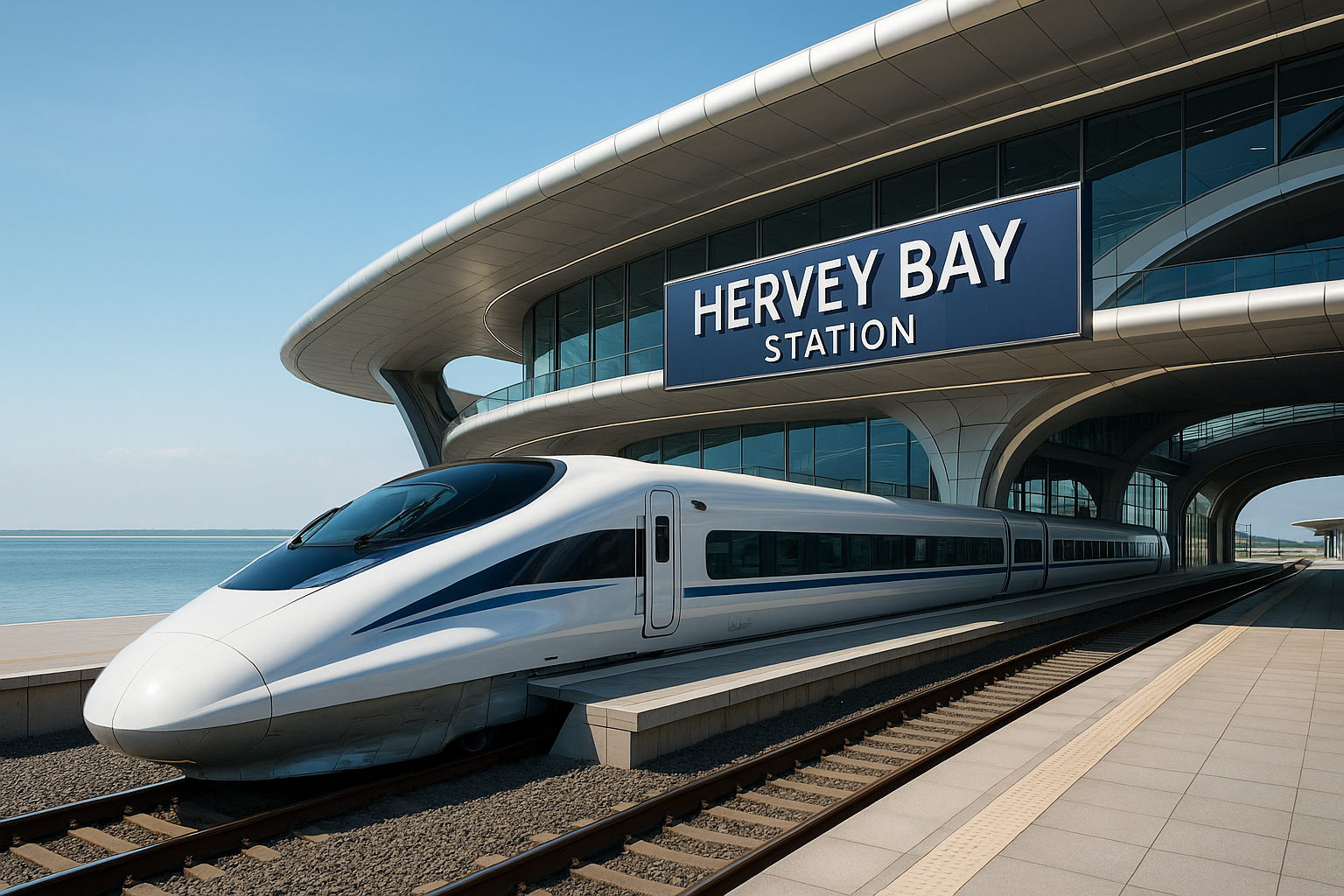
By 2100, a fast rail link along the coast won’t be a luxury, it will be essential, connecting emerging hubs like Hervey Bay with Brisbane, Sydney, and beyond.
Right now, such a project may seem financially impossible. But 75 years from now, failing to at least reserve the corridor, and to ensure Hervey Bay is on that line, will seem like a glaring oversight.
The future isn’t an abstract concept. Let’s start planning now for a Hervey Bay that’s bustling, connected, sustainable, and ready for the next 25 and 75 years.